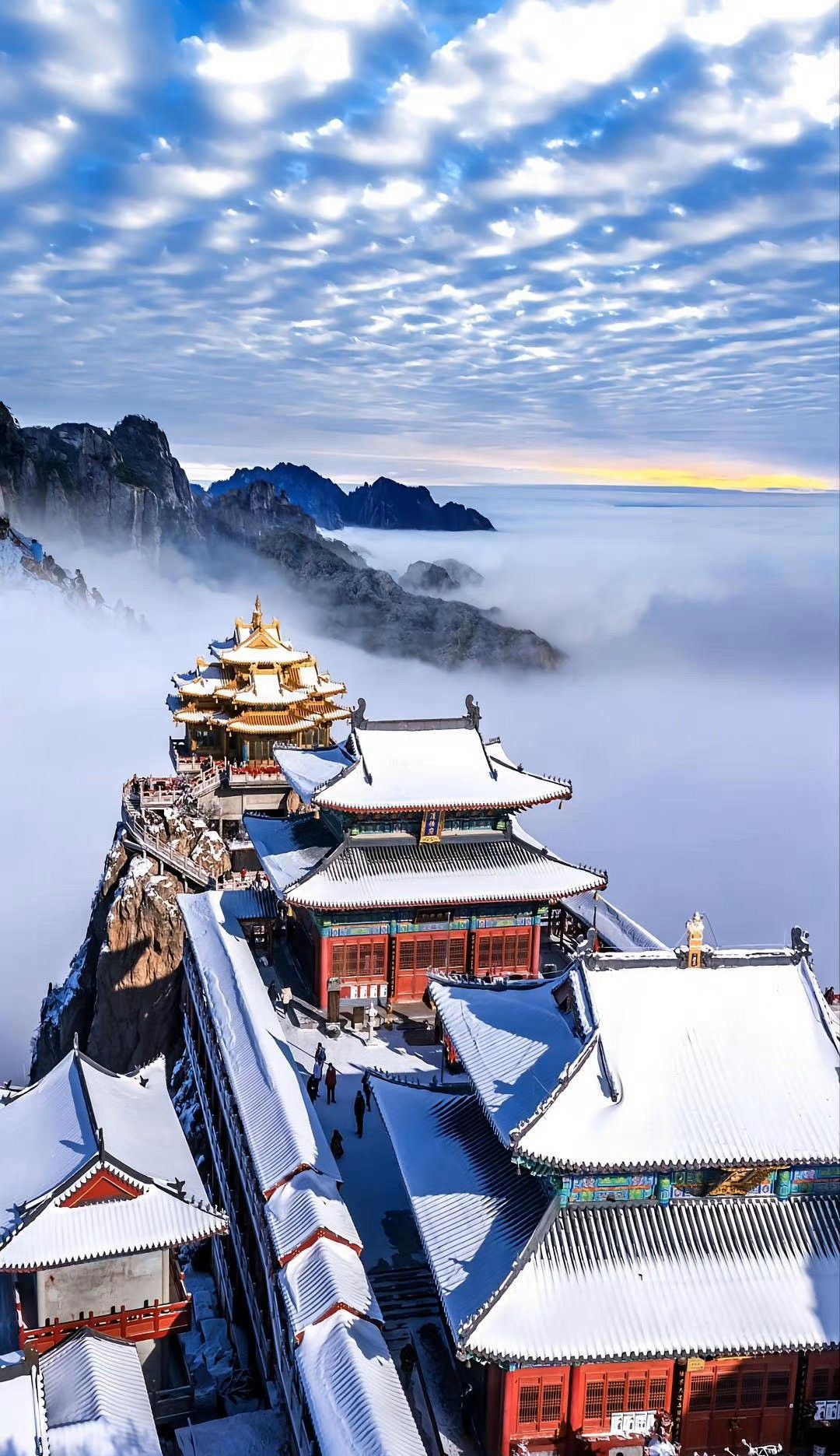
The Historical Origins of Taoism
Taoism is an indigenous Chinese religion that originated in the Eastern Han Dynasty (around 1,800 years ago), though its philosophical roots date back to the era of the Yellow Emperor and Laozi.
-
Key Figure: Laozi(老子) (6th century BCE) is revered as the founder of Taoism. His book, the Tao Te Ching, introduced the concept of the "Tao" — the natural order governing the universe.
-
Development:
-
Zhang Daoling(张道陵) of the Eastern Han Dynasty established the "Way of the Celestial Masters," formalizing Taoism as an organized religion.
-
Taoism integrated ancient animism, the Yin-Yang theory, and wellness practices, aiming to achieve "harmony between humanity and nature."
-
Why Are the Wudang Mountains a Taoist Sanctuary?
The Wudang Mountains in Hubei Province are hailed as "the unparalleled sacred land and number one celestial mountain under heaven" for these reasons:
-
真武大帝的道场
Sacred Site of Zhenwu Emperor-
Legend says Zhenwu(真武大帝), the Northern Emperor of Heaven, attained immortality here. Emperors throughout history built temples here to pray for national prosperity.
-
-
太极拳的发源地
Birthplace of Tai Chi-
Zhang Sanfeng(张三丰), a Taoist priest in the Ming Dynasty, developed Tai Chi here, blending Taoist philosophy of "softness overcoming hardness" into martial arts.
-
-
Architecture in Harmony with Nature
-
The site preserves 33 Taoist structures (e.g., Purple Cloud Palace(紫霄宫), Golden Summit(金顶)), built along mountain contours to reflect "following the way of nature." It is a UNESCO World Heritage Site.
-
-
Cradle of Inner Alchemy
-
Taoists practice "inner alchemy" here — balancing body, energy, and spirit through breathing and meditation to attain longevity and enlightenment.
-
Connections Between Wudang and the Five Elements
Wudang's architecture and practices are deeply rooted in the Five Elements:
-
Directional Design: The Golden Summit(金顶) belongs to "Fire" (clarity), while Southern Cliff Palace(南岩宫) aligns with "Wood" (vitality).
-
Tai Chi: Movements incorporate generative and controlling cycles, e.g., "Ward Off (Water) vs. Roll Back (Fire)."
Wudang Today: A Spiritual Journey Through Time
Today, Wudang remains a pilgrimage site for Taoist practitioners and martial artists worldwide. Visitors can:
-
Observe Taoist morning and evening ceremonies;
-
Learn Tai Chi and wellness practices;
-
Hike to the summit and meditate amid sea of clouds.
The Wudang Mountains are not just a range but a living museum of Taoist thought — where every stone and tile whispers the wisdom of "action through inaction" and "unity of nature and humanity."